
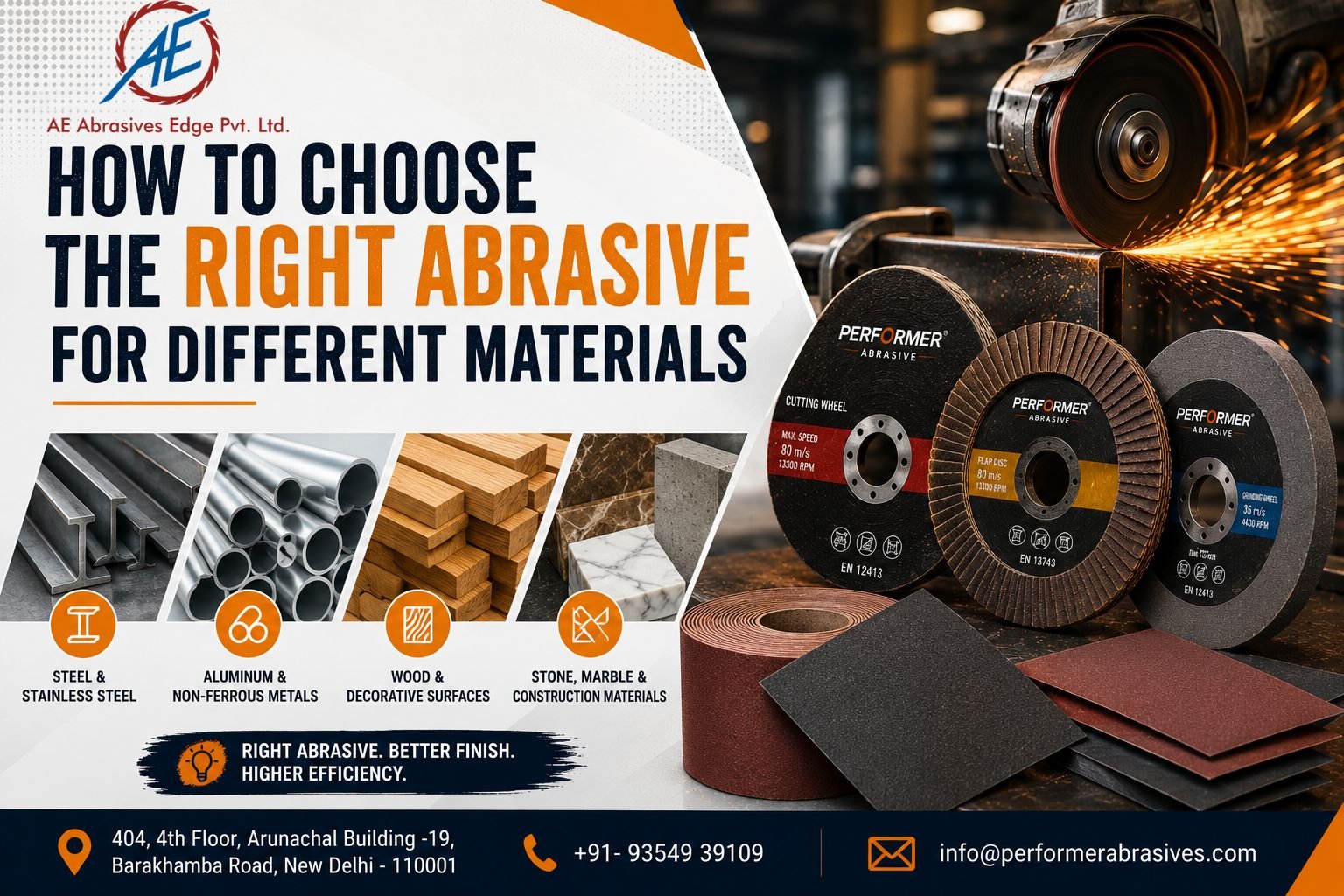
In production, quality of the end result is often determined even prior to the final finishing process, by selecting the proper abrasive. No matter what you are doing, whether it is cutting structural steel, polishing stainless steel, wood finishing, or natural stone forming, your choice of an abrasive affects efficiency, surface quality, durability of tools, and overall costs.
One of the mistakes often made by many industries is treating abrasives as interchangeable products. In fact, each material has distinct characteristics, and selecting an inappropriate abrasive may result in unsatisfactory finishes, overheating, excessive material wear, and frequent changes. We Performer Abrasive, stands as a leading Abrasive Manufacturers, we consistently suggest choosing abrasives based on the material, application, and intended finish instead of just considering the price.
Why The Right Abrasive Matters?
An abrasive is intended to reduce material effectively while ensuring accuracy on the final surface. However, no single abrasive is suitable for every application. Factors such as hardness, grain structure, operating speed & adhesive substance all affect performance. Choosing the right abrasive helps you:
- Achieve consistent surface finish
- Improves production efficiency
- Reduces material wastage
- Extends the life of tools & machines
- Lower overall production cost
- Enhance workplace safety
These benefits become even more significant in high-volume manufacturing environment where consistency is essential.
Choosing Abrasive Based on Material:
1. Steel & Stainless Steel:
Steel fabrication requires abrasive that can handle high pressure & continuous use. For grinding welds, removing burs or preparing surfaces, metal flap discs, fiber discs & grinding wheels provide excellent cutting performance while maintaining durability.
For accurate grinding applications, products developed by trusted tool room grinding wheel manufacturers are preferred because they deliver high tolerance & enhanced surface quality.
2. Aluminum & Non-Ferrous Metals:
Aluminum is softer than steel & can block standard abrasive if an appropriate product is selected. Choosing abrasive meant for non-ferrous metals helps in preserving cutting efficiency & avoid the excessive heat production.
By using the appropriate abrasive reduces loading, enable workers to operate more efficiently & achieve improved finishing outcomes.
3. Wood & Decorative Surfaces:
Wood needs careful sanding instead of harsh grinding. Items like Abrasive Paper Rolls, Sukha Paper, and Water Proof Paper are often used based on the need for either dry or wet sanding.
Gradually transitioning from rough to finer grit results in a sleek, professional appearance while maintaining the material’s natural grain.
4. Stone, Marble & Construction Materials:
Natural stone and concrete require particularly strong abrasives because of their toughness. Marble cutting blades, cutting wheels, and strong grinding solutions that are extensively used in construction, fabrication, and stone processing sectors to ensure accuracy and durability.
Factors to Consider Before Buying Abrasive:
Selecting an abrasive should involve more than simply matching it to a machine. Consider the complete application:
- Material type & hardness
- Required finish quality
- Cutting or grinding speed
- Machine specification
- Production volume
- Operator safety
- Abrasive life & replacement frequency
A slightly higher-quality abrasive often delivers better long-term value by reducing downtime and increasing productivity.
Common Mistakes That Reduce Abrasive Performance:
Many performance issues arise from incorrect usage rather than product quality. Avoid these common mistakes:
- Using the same abrasive for different materials
- Choose the wrong grit size
- Applying excessive pressure
- Ignoring recommended operating speed
- Continuing to use worn out abrasives
- Purchasing based only on initial cost
Why Quality Abrasive Makes a Difference?
Industrial uses require reliability. Inexpensive abrasives might appear cost-effective at first, but they tend to damage rapidly, produce too much heat, and need to be replaced often.
A reliable items from reputable Grinding Wheel manufacturer, Abrasive Paper manufacturer, and various skilled abrasive solution suppliers provide:
- Consistent cutting performance
- Better surface finish
- Longer operational life
- Reduced machine downtime
- Improved operator safety
Why Choose Performer Abrasive?
At Performer Abrasives, we combine industry experience with an extensive selection of abrasives that can be tailored to meet different industrial needs. Ranging from sandpaper, grinding wheels to flap disc, polishing materials and cut off tools, each item has been crafted to offer consistent quality and high performance.
We do not only sell abrasives, we also guide our clients on how to choose the best suited item for their specific applications.
Best Abrasive Manufacturer – Performer Abrasive:
Choosing the correct abrasive will greatly enhance the efficiency of manufacturing operations and the quality of products as well as reducing cost of operation. Rather than opting for a blanket method of selecting abrasives, consider the properties of the material, application, and finish you desire. Working with an expert abrasive partner such as Performer Abrasives guarantees performance-oriented solutions.
Frequently Asked Questions:
1. How do I determine the correct abrasive to use?
Before determining the abrasive that will be used, consider the type of material, hardness, finish, machine capability, and production needs.
2. What is the best abrasive for stainless steel applications?
Metal flap discs, fiber discs, and high-quality grinding wheels are among the typical abrasives used for stainless steel fabrication and finishing.
3. Why should you care about grit size?
Coarser grits are fast cutters, whereas fine grits yield smooth surfaces, making them perfect for polishing and finishing.
4. How can good abrasives increase productivity?
Good abrasives offer fast cuts, better performance, extended life span, reduced machine downtime, and decreased operational costs.