
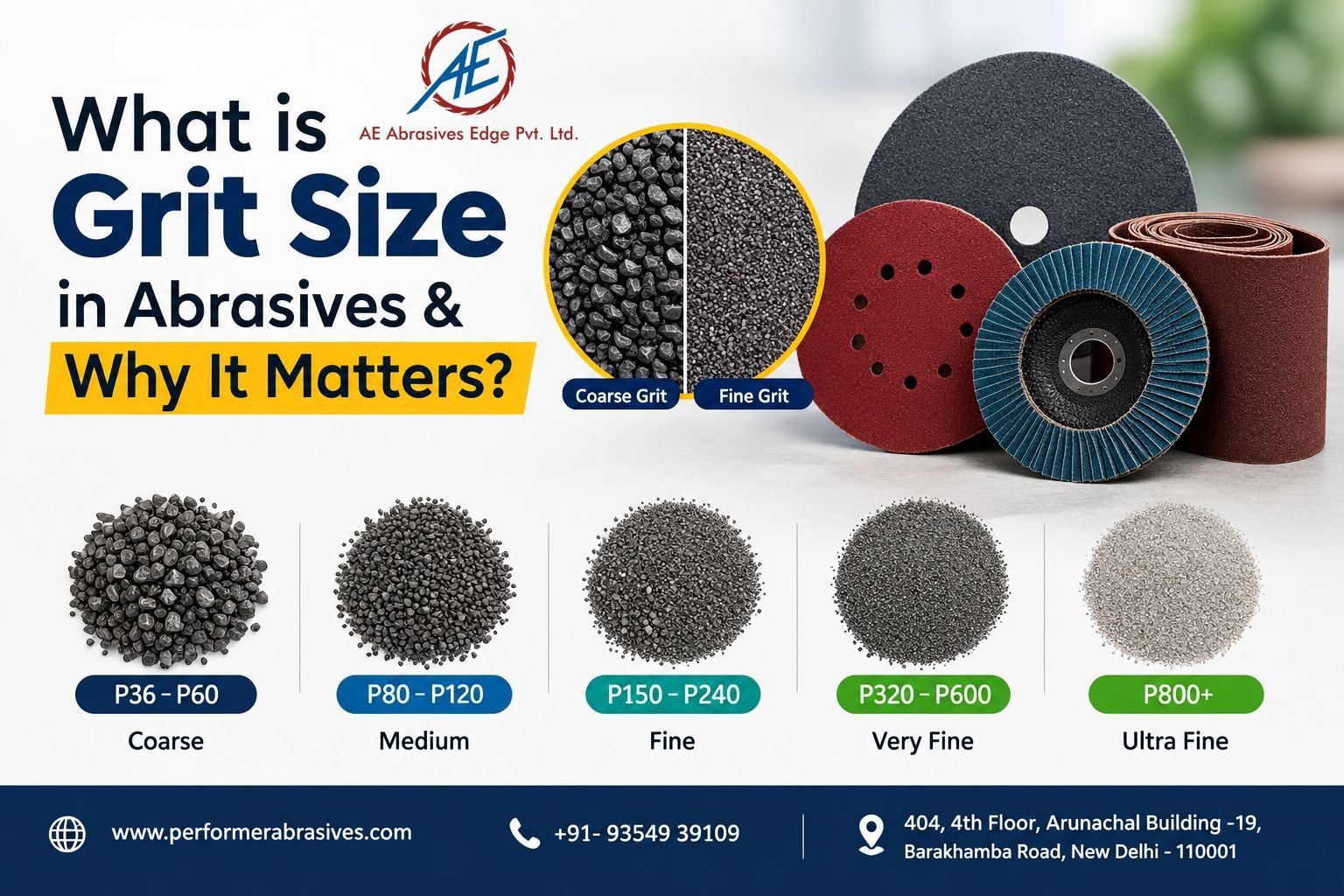
Grit size is an important parameter to consider when choosing industrial abrasives since it influences factors such as removal rate, surface finish, cutting effectiveness, and longevity of the abrasive. Whichever abrasive product you decide to choose, whether for surface preparation using abrasive papers or manufacturing using grinding wheels, the correct choice of grit size is essential.
Industries buying their abrasives from Abrasive Paper Manufacturers or looking for industrial cutting solutions need to know about grit sizes using Performer Abrasives.
What Is Grit Size in Abrasives?
Grit size describes the size of the abrasive grains used on various abrasive materials, including abrasive paper, discs, belts, and wheels. In most cases, a low grit number means larger particles, while a high grit number means smaller particles.
The common classification includes:
- Coarse grit: Rapid removal of material
- Medium grit: Moderated removal and surface preparation
- Fine grit: Surface finishing and preparation
- Very fine grit: Finishing and polishing
Why Does Grit Size Matter?
Grit choice impacts how abrasive attacks the surface:
- Removal of material: Coarser grit is ideal for rust, paint, welding, and burr removal.
- Finish of the surface: Finer grit results in smooth surfaces without much scratch marks.
- Efficiency of cutting: Choosing the correct grit and proper wheel construction helps in efficient cutting.
- Lifetime of abrasives: Choosing the proper grit may minimize abrasives’ wearing out prematurely.
Thus, it is not about choosing either the coarsest or the finest grit but about choosing an appropriate abrasive from leading abrasive paper manufacturers like Performer Abrasive.
Coarse vs Fine Grit: Which Should You Choose?
| Grit Type | Primary Use | Typical Applications |
| Coarse | Heavy material removal | Rust, paint, weld, and burr removal |
| Medium | General preparation | Grinding and surface preparation |
| Fine | Surface refinement | Smoothing and finishing |
| Very Fine | Final finishing | Polishing and fine surface work |
How to Select the Right Grit Size?
Factors for selecting suitable abrasive grits are listed below:
- Type of workpiece material: Depending on the workpiece material (steel, stainless steel, aluminium, and others), various abrasive grades can be needed.
- Amount of material removal: Coarser abrasives are required for heavy stock removal, whereas for finishing, finer grits have to be selected.
- Surface finish requirement: Choose the right grit for the specified surface finish.
- Machine type and speed: Type of equipment, its speed, and pressure must match the abrasive product.
- Application: Abrasives for grinding, deburring, polishing, and cutting purposes are all different from each other.
In the case of cutting applications, cutting wheel makers take into account the grit specification along with others (grain type, bond, etc.).
Select Abrasives for Reliable Performance
Grain size is an excellent place to start, but there’s more to an abrasive specification than that. The proper combination of grit, grain, bond, and construction of the abrasive can lead to improved efficiency and effectiveness.
Performer Abrasives offers application-focused abrasive solutions for industrial cutting, grinding, surface preparation and finishing requirements. The right abrasive selection helps abrasive paper manufacturers & cutting wheel manufacturers to achieve consistent performance while maintaining process efficiency and quality.
Frequently Asked Questions:
- What does a higher grit number mean?
A higher grit number generally indicates finer abrasive particles, which is suitable for smoother finishing and polishing. - Is coarse grit better than fine grit?
None of them is universally better. Coarse grit is preferred for material removal, while fine grit is used for finishing and surface refinement. - Can the same grit be used for different materials?
Not always. Grit selection depends on the workpiece material, application, required finish, and abrasive type. - How do I choose the right grit for an abrasive paper?
Consider the material, amount of material to be removed, and required surface finish before selecting the appropriate grit.